More available moves
Leadership retains meaningful responses when conditions change.
Decision architecture for leaders
INTRALIGNMENT™ is the condition in which decisions within an organization reinforce rather than restrict one another.
A restricting decision is not automatically a bad decision. The framework makes the restriction, tradeoff, and downstream consequence visible so leadership can decide whether it is intentional, understood, and acceptable.
CEOs
Founders
Operations leaders
Supply chain executives
The INTRALIGNMENT outcome
The destination is visible. The diagnostic route, scoring logic and interpretation remain inside the book and the INTRALIGNMENT Audit™.
Leadership retains meaningful responses when conditions change.
Restrictions are recognized before they quietly become organizational constraints.
Leaders debate the actual consequence instead of merely defending the original decision.
One department’s solution is less likely to become another department’s obstacle.
When present economics require options to narrow, leadership understands why.
Today’s decision makes tomorrow’s decision easier.
The question leadership rarely asks
“Here’s something your current decision may be restricting. Is that restriction intentional, understood and acceptable?”
INTRALIGNMENT™ does not answer that question for leadership. It makes the question and the evidence surrounding it difficult to avoid.
The INTRALIGNMENT Audit™
The Audit gives leadership a clearer view of where current choices reinforce one another, where they narrow future options and whether those restrictions are acceptable.
Request an audit conversationWhat leadership gains
The complete diagnostic sequence and interpretation remain proprietary.
The credibility standard
No manufactured authority. No statistics without provenance.
Pattern recognition has value without being dressed up as proof.
Correlation is not quietly promoted into causation.
The framework makes room for what leadership still needs to learn.
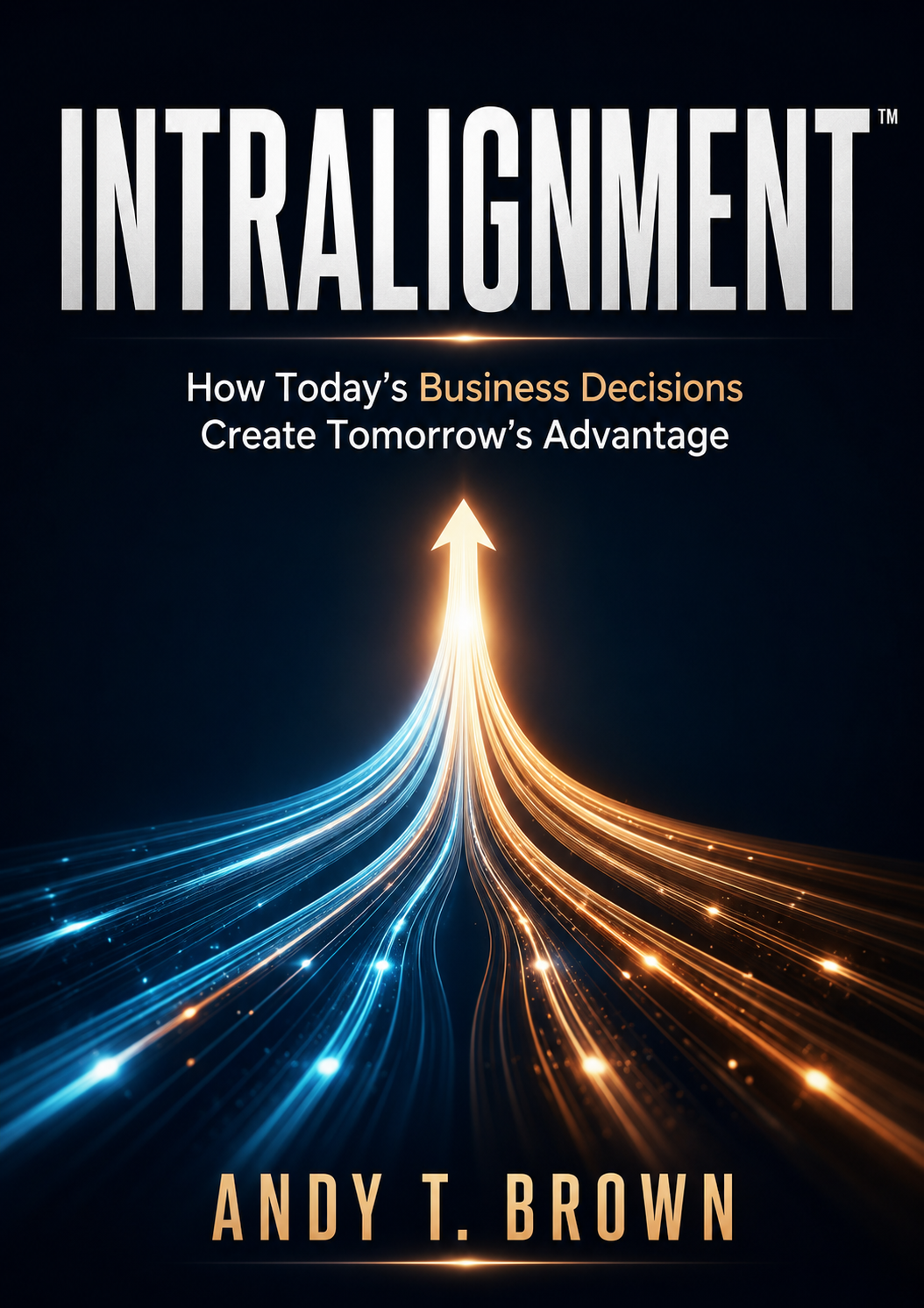
The book
INTRALIGNMENT uses freight and supply chain as its proving ground, then applies the lessons to any organization where individually defensible decisions have quietly stopped working together.
Direct purchase · Ships from Andy
Purchase from Andy through Stripe
Orders are charged securely through Stripe. Expected to ship beginning September 4, subject to final proof approval.
One idea. Three connected roles.
Names and explains the decision framework.
Applies it to freight, operations, and decision systems.
Writes, teaches, facilitates, and challenges the framework.
For leadership teams
It is whether the decisions still work together.
Request an executive conversation